Three tobacco layers and a finishing touch, all put together by hand. Here's what each one does.
Cross-section of a cigar
The parts
Wrapper
The outer leaf you see and touch. It is chosen for appearance, elasticity and flavour, and it is wound around the cigar in a spiral.
A cigar made in Nicaragua does not necessarily use a Nicaraguan wrapper: the wrapper can come from Nicaragua or from another country, depending on the blend. Check the specific cigar before assuming its origin.
Binder
A leaf rolled around the filler to hold the bunch together. It sits under the wrapper and is rarely seen.
Binder leaf is usually sturdier than wrapper leaf. Like the other parts, its origin depends on the blend.
Filler
The bunch of leaves that forms the body of the cigar. It is usually a blend of several tobaccos.
How the filler leaves are arranged inside the bunch affects how the cigar draws and burns. Blenders combine leaves from different plants, regions and harvests.
Cap
A small piece of leaf that closes the head of the cigar and keeps the wrapper from unravelling. It is a finishing piece, not a fourth layer.
You cut or punch the cap before smoking. The head is the capped end; the foot is the open end you light.
Made by hand
Nicaragua's premium cigars are rolled by hand
A buncher gathers the filler and binder, a roller finishes it with the wrapper and cap. Watch how it's done.
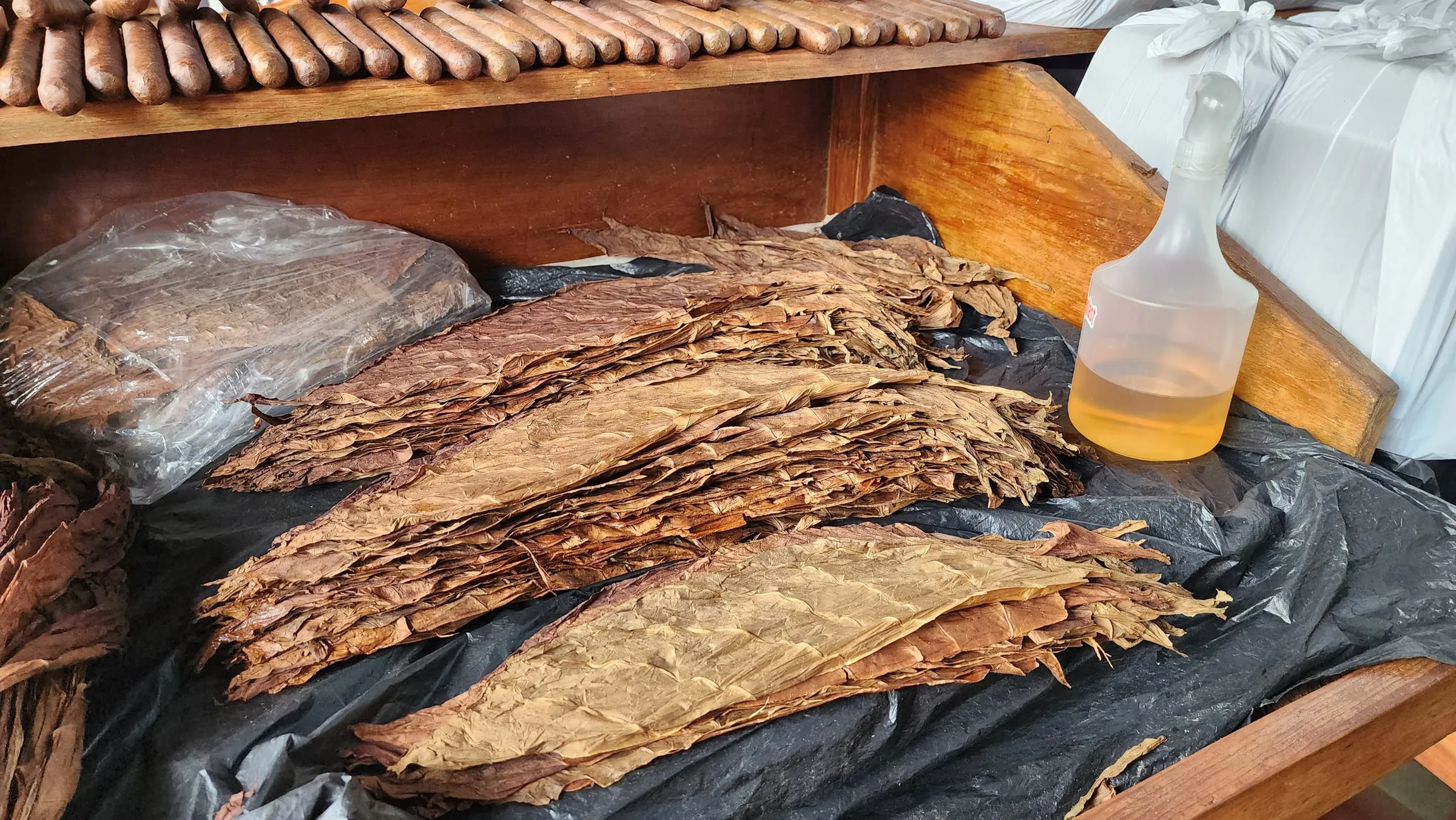
Before rolling: dried leaf at a bench, ready to become filler, binder and wrapper. Our own photo from Doña Elba Cigars in Granada.
Why Are Cigars Still Made by Hand?Aganorsa Leaf
Blending
One cigar, many places
Blenders mix leaf from different valleys, plants and harvests, and sometimes different countries, to build a flavour. A cigar rolled in Estelí might carry filler from Jalapa and Condega and a wrapper grown far away.